

The Harmonized Tariff Schedule (HTS) functions as a comprehensively detailed document allocated by the government or relevant bodies for classifying goods and regulating trade. This document is essential for devising tariff policies, ensuring the due collection of monetary duties, and facilitating the seamless import and export of goods. The HTS offers a hierarchical, collected numbers order for labeling goods based on their characteristics, which seem to be their composition and function, which aids in applying tariffs and trade figures. This guide aims to explain the structure, purpose, and practical application of the HTS, thus empowering international businesses to make trade more manageable by the full understanding of global regulations.
What is an hts code and Why is it Important?
Definition of hts code
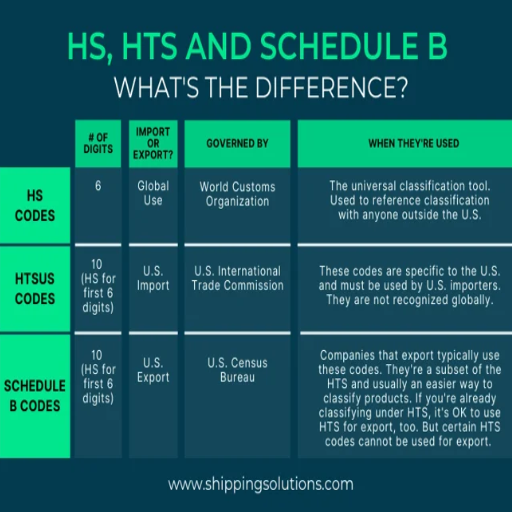
HTS code or Harmonized Tariff Schedule code is a 10 digit figure used to classify the imports and exports of a particular country and is specific to the US. The classification is built upon the global Harmonized System (HS) managed by the World Customs Organization (WCO) to accommodate the US trade. The first six digits of HTS coordinates correspond to the international HS system, while the United States sets the last four digits to facilitate additional specificity. The codes are pertinent to setting tariffs, adhering to trade regulations, and constructing trade statistics.
Significance of harmonized tariff schedule in international trade
The Harmonized Tariff Schedule (HTS) simplifies trade internationally because it provides a class for every good. It allows products to be identified in different parts of the world, which minimizes the chances for error during customs checks. HTS codes play an essential role in setting tariff charges on goods which aid in calculating accurate trade invoicing. Furthermore, they support trade compliance, help curb trade conflicts and ease the collection of trade data that helps formulate economic policies. The HTS fosters efficiency and, therefore, enhances trade around the globe.
In what ways does HTS correlate with customs duties?
The customs duties for imported materials are legally confined under the Harmonized Tariff Schedule (HTS). Each product within the HTS is assigned a code based on its description, composition, and purpose, which customs officials utilize to determine applicable duty rates. Precise classification under HTS promises adherence to tariff laws and aids in averting over and underpayment of duties and reducing charges and time lost in customs clearance delays.
How does an hts code?

Methods for determining hts number
1. Step 1: Analyze the product specifications
Accumulate complete details regarding the product’s structure, purpose, manufacturing process, and relevant features. Accurate and complete product descriptions are the key to precise subcategorization.
2. Step 2 Use the HTS website
The website of the U.S International Tariff Commission (USITC) holds the official HTS schedule, so use the search option by entering product-related words that describe its material, function, or even a term associated with the industry to find possible results.
3. Step 3: Look through pertinent classifications
Ensure that the chosen HTS classification section’s language and descriptions correspond with the item’s technical features. Search for the relevant sections and chapters to find the one that best fits the classification.
4. Step 4 Check with customs CROSS system
Using CROSS and other similar systems, check the previous rulings made concerning your product classification or similar items to avoid possible misidentifications.
Tools for hts code lookup
1. USITC Harmonized Tariff Resources
The United States International Trade Commission (USITC) has a dedicated webpage that contains a Harmonized Tariff Schedule (HTS) lookup tool and keyword search capability. This tool, along with the website’s other features, has plenty of information vital for ensuring compliance and ease in classification. The HTS search can be found on the website [HTUS ITC](https://hts.usitc.gov/).
2. Customs Border Protection (CBP) Rulings Database
CBP’s site also contains numerous resources, including CROSS, which allows users to search for binding rulings of HTS classifications. CROSS is very useful when dealing with uncertainty or ambiguity concerning product categories or confirming previous classifications. Visit CROSS at CBP’s Rulings Portal.
3. Export.gov Trade Resources
Export.gov has numerous avenues to assist American business and commerce, especially concerning international trade. Export.gov has HTS code search and classification tools that assist both exporters and importers with helpful information and links to the relevant databases held by government agencies. Visit Export.gov for more details on HTS Resources.
Common Errors Pertaining to HTS Codes
1. Oversimplifying Classifications
The most common error is choosing HTS codes that are too simple or general. Such choices may lead to incorrect duty rates, lost duty-free opportunities, or other compliance problems with customs. This issue is easily mitigated by highlighting subheadings and pertinent notes within the HTS.
2. Ignoring product detail breakdown
Many users tend to forget essential features of a product, such as material, size, and use type when dealing with HTS codes. Classification by HTS is only possible if the user has sufficient knowledge of the product in question and the descriptions provided in the tariff schedule.
3. Failing to read legal notes and definitions
Selecting the erroneous code may stem from a failure to read or misinterpret the legal notes accompanying the HTSs. Such notes are critical in framing provisions in which specific sections or chapters of the codes fall within manifesting boundaries so they can be grouped and in what way.
Consulting a trade specialist or reliable customs information sources would help businesses mitigate risks and ensure compliance.
Understanding the structure of hts codes

Decoding the 10 Digit HTS Codes
Every product that enters the country has a unique identification number known as the Harmonized Tariff Schedule Code or HTS code. It further aids in the organized classification for customs procedures. The HTS code is divided into the following components :
- Chapter (First 2 Digits): The first two digits categorize the product into its higher-level scope. “85” deals with electrical machinery, equipment, and other industries.
- Heading (Next 2 Digits): The subsequent two digits specify further classification into strata under the chapter. In this case, “8504” deals with transformers and power supplies.
- Subheading (Next 2 Digits): The fifth and sixth digits provide an even more specific classification by detailing types included in the heading.
- Statistical Suffix (Last 4 Digits): The last four digits are extensions specific to the country that help refine the classification to domestic aids. It enables easier monitoring of imports and the corresponding tariffs.
It ensures accurate classifying and yields greater compliance with trade guidelines when correctly combined.
The Significance Behind the Initial Six Digits.
The first six digits of a Harmonized System (HS) code are the foundational reference and core classification category that each product falls under. The first two digits represent the chapter, the broader industry (such as chemicals, textiles, machinery) under which the product is categorized. The following two digits identify the heading, which subdivides the broader category to closer and more specific classifications. The last two digits form subheadings that classify the product on a much finer level so that there is complete consistency across the globe. This structure, which is comprised of six digits, is of utmost importance to international trade as it forms a standard framework that makes customs detailing easier and ensures accurate identification of products across borders.
Classification of products in a harmonized system
The harmonized system (HS) groups products in terms of their sections, chapters, headings, and subheadings, creating a hierarchy. First, products are organized into 21 sections, which are further divided into 99 chapters representing broader categories like raw materials and manufactured goods. In these chapters, headings and subheadings give them further classifications that narrow down materials, products, or purposes. Each product is given a six-digit HS code for classification purposes. The uniformity of the system helps international commerce by simplifying tariff and customs procedures, making communication, which can be challenging for global trade, easier.
How does the harmonized tariff schedule affect import and export?

The importance of HS code in export customs clearance
The role of the “HS” code in exports is critical for accurately classifying goods as it directly impacts trade profitability. This system is of great help to exporters because they can determine applicable tariffs, obey the trade laws of the particular country, and facilitate seamless customs clearance. Correct classification using HS code minimizes gaps in documentation, lowers the risks of sanctions, and ensures smooth shipping and other operational processes. Moreover, such a code allows for tracking of market changes and statistical purposes, which is useful to exporters when competing in international trade. As a result, the HS code guarantees effortless compliance with legal requirements concerning exports.
Impact on the efficiency of importing goods custom clearance
The impact of the Harmonized System (HS) code in importing goods is directly related to the speed and efficiency of clearing customs, which subsequently saves time and resources. It accomplishes this task by ensuring that products are classified and labeled the same way at customs all over the globe. By categorizing the products under the correct HS codes, customs can apply the correct tariffs, taxes, and rules, significantly minimizing errors that result in unnecessary shipment delays. Also, proper usage of HS codes facilitates auditing and inspection as they synchronize required documents with the actual global demand. Failing to use correct HS codes attracts unnecessary repercussions, intimidation, and denial of goods clearance, proving that compliance accuracy is necessary to allow more efficiency when dealing with imports.
The impact of trade agreements on hts codes classification
The implementation of trade agreements is essential to applying and classifying HTS codes, as it defines the tariff rates and the rules of origin applicable to goods traded between member countries. About free trade agreements (FTAs), some goods are eligible for lower or zero tariffs if they fall under a particular HTS classification that meets specific origin requirements. Usually, these agreements have specific rules for certain products and protocols for preferential treatment that require precision in classification for exporters and importers to benefit from the agreements. Incorrectly applying HTS codes out of sync with trade agreements comes with consequences such as penalties, denial of referred tariffs, or even customs hold ups, which proves the need for compliance with regulations and the influence of trade agreements.
What are the general rules of interpretation for hts codes?

Outline and highlight the rules created by WCO, the header’s terms, and the pertinent section or chapter notes to determine the classification.
The WCO has established the Harmonized Commodity Description and Coding System, also known as the Harmonized System (HS), which has a set of General Rules of Interpretation (GRI) that must be followed. These rules are fundamental when assigning commodity classifications in the Harmonized Tariff Schedule. There are six GRI that tell the user how to classify the product according to a set procedure:
- In Rule 1, the user is reminded that the headings’ phrasing and relevant notes in the section or chapter will determine classification.
- In Rule 2(a), incomplete articles are called finished products, but they need to retain the essential character of the completed article. Rule 2(b) applies to mixtures or combos of substances.
- Rule 3 settles classification disputes by giving the most specific heading priority, followed by those which are composite goods assessed on their essential character or, only if all else fails, the last one assigned in numeric order is used.
- Rule 4 states that goods not covered by described headings are categorized under the ‘other’ heading most like the description.
- Rule 5 details other categories for classifying packaging materials and cases that are meant to be used with the products for a long time.
- Rule 6 maintains the same level of precision as the Fifth Rule by applying determinations of preceding rules to subheadings.
These regulations provide a complete and organized system of categorizing products that guarantees consistency in applying HS codes worldwide. Accuracy in international trade activities heavily relies on compliance with the GRIs.
How to interpret classifications
To interpret classifications under the HS, one needs to have a methodical understanding of the General Rules of Interpretation as well as the necessary structure. Start with evaluating the features and intended use of the product to select the relevant section and chapter. Next, move to specific headings and subheadings applying Rule 1 which prescribes classification by the terms of the heading and relevant section or chapter notes. If the classification is ambiguous, use the other GRIs systematically, such as Rule 3 for composite goods, to provide clarity. Always check explanatory notes, which aid greatly in classification by giving examples. Review changes made to HS codes and other legal decision documents pertaining to international trade to stay up to date with the imposed rules.
Practical Application of the Rules
- Example 1: Classification of a Smartwatch
To classify a smartwatch under the Harmonized System (HS), it is necessary to start with GRI 1: determination of its essential character. A smartwatch has the features of a watch, a phone, and an advanced personal health monitor all in one device. As much as it serves in the capacity of a watch, its primary purpose is more akin to that of a mobile phone and computer. Therefore, looking at the appropriate HS parts, it would generally be placed in Chapter 85 as an “electric apparatus for telecommunications.” Some of the technical specifics supporting this classification are its central processing unit (CPU), mobile communication interfaces such as Bluetooth and Wi-Fi, and the health sensor used for monitoring. Following Rule 3(b), it can be accepted that this unit’s essential function supersedes a clock’s function, thus confirming its characterization under this heading.
- Example 2: A blended coffee machine’s classification.
A coffee machine with grinding and milk foaming included systems requires evaluation through GRI 1 regarding its classification. The older functionalities can also enhance the device’s dominant purpose of serving coffee. According to Rule 3(b), the most significant characteristic of a coffee machine is its ability to brew coffee; therefore, this will classify it under the sub-heading of Chapter 84, “machinery for the preparation of beverages,” as a coffee preparing machine. The espresso machine’s pump pressure (for instance, 15 bars), integrated grinder’s burr material and grind settings, and the ability to steam milk are the technical parameters that justify this. Additional notes provide grounds for considering the machine complete and operative for its principal function of beverage preparation.
In cases of international trade requirements with vague notions, it is necessary to provide explanation notes and detailed technical requirements to change for classification compliance.
Reference sources
United States International Trade Commission
Frequently Asked Questions (FAQs)
Q: What is the HTS code definition and why is it important for 2025?
A: The HTS code definition refers to the Harmonized Tariff Schedule code, which is a 10-digit number used to classify traded products. It is crucial for 2025 as it determines tariff rates and statistical categories for merchandise imported into the United States.
Q: How do I find the HTS codes for my products?
A: You can find the HTS codes by using the “Guide to HTS Codes” available on the official U.S. International Trade website, where you can search by product description or schedule B codes.
Q: What is the relationship between HS and HTS codes?
A: The HS code stands for Harmonized System code, which is an international standard for classifying goods. The HTS code, specifically used in the United States, builds upon the HS code by providing further classification and tariff rates specific to U.S. imports.
Q: What are the General Notes related to HTS codes?
A: The General Notes outline the principles and rules regarding the classification of goods under the HTS codes, detailing how different products are categorized and what legal standards apply to them in the United States tariff schedule.
Q: How are temporary legislation changes reflected in HTS codes?
A: Temporary legislation changes can affect HTS codes by altering tariff rates or product classifications. These changes are included in the current HTS and are essential for importers of record to ensure compliance with U.S. trade laws.
Q: Why is the Schedule B number important for U.S. international trade?
A: The Schedule B number tracks exports and is crucial for statistical purposes, allowing the U.S. government to analyze trade patterns. It works alongside HTS codes, particularly when classifying products for export.
Q: How does the HTS code apply to supply chain management?
A: HTS codes classify products within the supply chain, helping to understand shipping costs, import duties, and compliance requirements while facilitating smooth customs clearance for merchandise imported into the United States.
Q: Can I use the HTS code for international trade outside of the United States?
A: While HTS codes are specifically designed for the U.S., understanding the corresponding HS codes can help when trading internationally, as these are recognized globally under the international harmonized system.
Q: How can I ensure I use the correct HTS code for my imported products?
A: To ensure you are using the correct HTS code, refer to the official “Guide to HTS Codes,” consult with a customs broker, or contact the U.S. Customs and Border Protection for guidance on the appropriate tariff code for your products.


