

A Request for Information (RFI) is a formal procedure businesses or organizations use to obtain organized and detailed information from prospective vendors, suppliers, or service providers. It is an integral part of the planning processes or even procurement scopes as it assists with decision-making supported by evidence. An RFI`s objective is to eliminate profiled options while defining the capabilities of products or services and determining the correspondence of particular projects or organizational goals. This article will help you appreciate the RFIs within the procurement context and understand the dos and don’ts for efficient drafting and answering RFIs. Here, we will explain the features of RFIs, their advantages, and how to leverage them for better decision-making.
What is the Meaning of RFI?

How is RFI considered in procurement?
RFIs, are documents sent to suppliers or vendors to obtain detailed information from them. They are instrumental in the beginning of procurement, where information about products, services, and capabilities regarding the offered market is gathered. An RFI is not a bid or proposal that requires a sponsor but rather an attempt to enlighten decision-makers on possible solutions, systems competencies, and mark standards that exist so that this personnel can narrow down what procurement needs and strategies to construct. Organizations can narrow down suitable suppliers for the RFP and RFQ decision-making stages through this RFI-focused approach.
What information is typically captured in an RFI?
An RFI document usually contains a concise statement of the organization’s needs or problems to be solved, an outline of the goals that need to be fulfilled by the solution, and questions meant to probe the vendor’s capabilities. It may ask for the supplier’s experience, relevant technical offerings, and available functionalities and equities features that could make their product or service unique. It frequently solicits timelines, cost estimates, and general responsiveness to compliance standards or regulations. With these items included, it becomes possible for companies to assemble relevant information and assess what suppliers do meet their expectations in the preliminary stages of buying.
Why is understanding RFI meaning important for businesses?
Knowing the meaning of RFI (Request for Information) is vital for businesses because it acts as a framework to capture scopes of work, evaluate ideas, and undertake vendor pre-qualification. Organizations using RFIs get to obtain useful information about what the markets offer before making firm commitments to any of them. This certainty goes a long way in in streamlining procurement cycles, making sure the decisions that are taken are based, and ensuring that the defined project objectives correspond to the capabilities provided by the suppliers. Proper use of RFIs helps businesses avoid misunderstanding, eliminate unnecessary risks, and improve the selection of workable solutions about operational and budget control requirements.
How does RFI differ from RFP and RFQ?
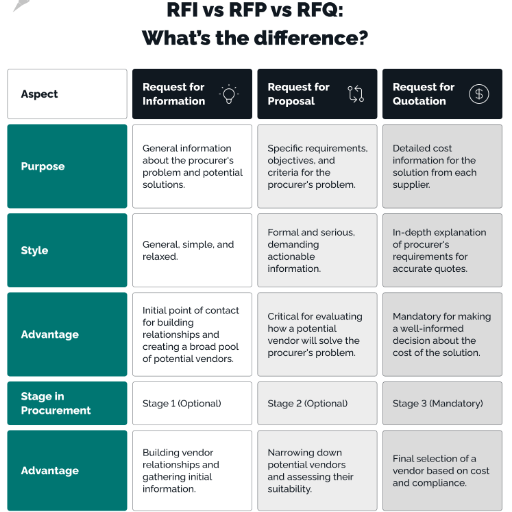
What are the key distinctions between RFI and RFP?
This exploratory document elicits description-based information such as an organization’s capabilities, possible solutions, vendors, and other details. It is called an RFI (Request for Information). An RFI is used in the initial procurement phases and aims to obtain market information, which assists in narrowing the scope of work without making any firm decisions. An RFP (Request for Proposal) is issued to receive comprehensive proposals. This document contains all the requirements, including the technical details, implementation strategies, and costs expected from the vendors. Unlike an RFI with a clarifying information component, an RFP is conclusive, soliciting the evaluation and selection of the most suitable vendor.
In what aspects does RFI differ from RFQ?
An RFI, or ‘Request for Information,’ is generally used to solicit broad information from vendors concerning their products or services about what is available in the market. It is more of an abstract request and typically does not capture any cost-related figures. In contrast, an RFQ, which stands for ‘Request for Quote,’ is more precise and is used to acquire accurate cost figures for a specific service or item. While an RFI identifies potential vendors and their solutions to a problem, an RFQ is issued when the purchasing organization is ready to decide based on pre-defined requirements and budget.
RFI or RFP: Which do you use when?
You should employ an RFI in the preliminary stages of procurement when there is a need to establish an understanding of the vendors, their capabilities, and possible solutions to consider. It is helpful to map out the market and improve your project requirements without reservation, along with a putative business. On the other hand, when you understand your requirements quite well and are looking for proposals from vendors that include not just solutions but also pricing, timeframes, and implementation plans, an RFP works best. An RFI will help you learn and screen your options, while an RFP will help you evaluate formal bids and decide.
What is the RFI Process?

Which are the primary procedures in the RFI process?
Clarity, ease, and gathering pertinent data are essential in the RFI process. Outlined are the steps that were taken, with some steps involving technical details if needed:
1. State Goals
State what the RFI is meant to achieve and what information it seeks to obtain. Describe the system requirements that need to be fulfilled, including, but not limited to, scalability, compliance norms, and integrations or peripheral systems.
2. Set up the RFI File
Structure the RFI document with specific sections, such as a project description, detailed outline of questions, evaluation suggestions, and deadlines. Also, include specific information, such as mandatory adherence to standards like those set by ISO or data security protocols.
3. Hand Out to Contracted Suppliers
Select qualified vendors on a base level and provide them with the RFI. If sensitive information is being sent, ensure that distribution is conducted through secure methods.
4. Compile and Analyze Replies
Put together the different responses and examine the information against the goals that were put forward. Pay special attention to technical indicators, such as implementation case study, performance metrics, and system interoperability.
5. Shortlist Vendors
Out of all responses received, choose vendors that satisfy the technical, functional, and business criteria outlined, and document reasons for selection with the justification matrices as needed.
6. Request Further Clarifications
Optionally, follow up with vendors for more information or ask for proof of compliance or prototypes to demonstrate.
This way, organizations can more easily filter their choices and build a basis for later RFQ or RFP steps.
How do you make the RFI process more efficient?
Organizations need to communicate clearly and effectively to make the RFI process more efficient. Start with creating an RFI document with an introduction, requirements, and clearly defined information to be gathered. Make use of generic templates so that there is uniformity in the documents and less time is wasted in document generation. Implement advanced tools like vendor management software or collaboration tools to issue RFIs, gather responses, and analyze the information. Also, the RFI should be limited to necessary questions that target the project’s goals to make it easier for respondents and quicker for reviewers. Lastly, the process must be assessed regularly and improved with every cycle using input and results from previous iterations.
Involved parties in the RIFI process.
An RFI process should consider important stakeholders capable of providing guidance and ensuring the project objectives are met. These include project managers, procurement specialists, technical subject matter experts, and user representatives. Also, executive sponsors might ensure oversight to confirm that the process meets the organizational objectives. Having different viewpoints assures that the organization can develop a thorough analysis of the vendor responses to aid in the decision-making process and improve the results.
What are the Best Practices for Using an RFI?

What primary components an RFI must contain?
1. Purpose and Scope Setup
Clearly state the aim of the RFI, along with the organization’s goals and issues, within a brief overview. This will allow the vendors to be near the project and enable them to scope the outline.
2. Specific Guidelines
Elaborate on the precise details of the information needed from the vendors. This information could include but is not limited to, product attributes, technical attributes, scalability, compliance standards, and service capacity. Specifying further will yield more actionable data.
3. Vendor Information
Provide vendor’s company background. Also, ask the vendor to provide the company’s experience and achievements and appropriate case studies. These are essential for establishing credibility for the company.
4. Focused Goal Questions
Structured and targeted questions that focus on critical decision-making are needed. These could also include charging structures, support services, and technology compatibility.
5. Response Instructions
Provide responses for which there is no ambiguity in the format, period, or submission method. This level of precision reduces the risk of misunderstanding while enabling consistency across the board.
6. Assessment Procedure
Let the vendor know how the answers would be analyzed and scored so there is no dishonesty. This avoids wasting time and allows for straightforward evaluation on the side or your team.
How to form a powerful RFI template?
It is essential to adopt an organized and succinct method to create an engaging RFI. Define the aim and extent of the information request to ensure all respondents comprehend the context and targets. An introduction, relevant contextual information, and specific questions designed to collect the information you seek are necessary elements of credibility. Divided boundaries within your queries, such as company profile, capabilities, pricing, and IT requirements, should be organized while ensuring no attempts at obscure or vague questions. Furthermore, layout submission details, including order, timeline, and contact information for further inquiries to be easy to follow. A guideline RFI template enhances comprehension and positive response while simplifying decision-making.
What are the common pitfalls in issuing an RFI need to be addressed?
When preparing an RFI, many mistakes can prove to be damaging. For example, a lack of clarity in objectives typically generates ambiguous responses. It is critical to ensure that the purpose of the RFI is clearly defined. Also, asking broad or irrelevant questions is hugely unproductive. It wastes both the issuer’s and the responder’s time. Focus on getting information that can be acted upon and is related to your requirements or expectations. Failing to provide adequate context is also a problem. Omitting project scope and other technical context can lead to responses that are either incomplete or unrelated to what is required. There is also a tendency to neglect detail in submission instructions. Vague instructions on formats, deadlines, or other particulars often lead to poor-quality responses. Addressing these shortcomings avoids an RFI process that is unstructured and ineffective.
How to Respond to an RFI?

What do you have to add when answering an RFI?
Response to RFI should start by providing background information about the organization, including relevant skills or knowledge and other relevant experience to the particular request. Tell us how you answered the questions or addressed the requirements contained in the RFI. Answers should be brief but complete and supported by data or examples where necessary. Develop a solution or answer to the proposed question or task within the project boundaries while demonstrating your value. Follow any provided instructions regarding formats, timelines, and submission processes. Add any optional materials you have to strengthen your answers, such as case studies or other certifications to help provide credibility and deepen your response.
What is the role of potential suppliers in responding to an RFI?
Suppliers are very important in giving as much detail as necessary in response to a Request for Information (RFI). The supplier’s goal must always be to explain their capabilities, products and in this case, service in line with the needs of the requesting company. Suppliers need to prepare an analysis of the RFI so that their answers are within the parameters of the questions posed, demonstrate knowledge, and even showcase how they could have an edge over competitors. That would assist the organization in determining whether the supplier is fit for the project. Also, the suppliers need to take this chance to show how they fully understand industry requirements, think of better ways to do things and build their reputation so that there will be some level of confidence and trust in the future.
What measures do you put in place so there is no misunderstanding in your RFI response?
To ensure your RFI response is clear, you must present it in a well-organized document with logical headings and subheadings. Use clear and straightforward language, conveying your ideas in a business manner and avoiding slang and overly technical words when possible. Make sure that relative aspects of each question are answered in depth and backed by elementary facts, data, examples, and case studies, if possible. Use visual aids like tables and bulleted items to break down intricate information and improve the document’s ease of reading. Edit the response and check very carefully and thoroughly for any mistakes so the final appearance of your response is professional and polished. Last, ensure that all of your answers align with the goals of the organization you are explaining so it is evident what their needs and priorities are, which will build the proposal.
Reference sources
Frequently Asked Questions (FAQs)
Q: What is RFI in the construction industry?
A: RFI stands for Request for Information. It is a document to gather information from vendors or subcontractors regarding a specific project or bid.
Q: How do RFIs differ from RFQs and RFPs?
A: RFIs are typically used to gather general information, while RFQs (Request for Quotation) and RFPs (Request for Proposal) focus on soliciting bids for goods or services. The main difference lies in the depth of information requested and the type of request being made.
Q: Why should a company consider using an RFI?
A: An RFI can help your company gather crucial information to make informed decisions during the bidding process. It allows for clear communication of project requirements and helps identify potential vendors or subcontractors that can meet those requirements.
Q: What are some best practices for creating a good RFI?
A: RFI best practices include being clear and specific about the requested information, keeping the document concise, and including a response deadline. This ensures you receive relevant and timely information, which is crucial for effective project management.
Q: How can I effectively respond to an RFI?
A: To respond to the RFI, provide detailed and accurate information that addresses all the queries raised. Ensure your response highlights how your product or service aligns with the project’s requirements. Utilizing a document management platform can also streamline this process.
Q: Can RFIs be used in other industries besides construction?
A: Yes, RFIs can be used in various sectors such as IT, healthcare, and manufacturing. Any industry that requires procurement of goods or services may utilize RFIs as part of their business process.
Q: What is the importance of real-time communication in the RFI process?
A: Real-time communication during the RFI process allows for immediate clarification of requests and responses, helping to keep the procurement process efficient and on schedule. It helps prevent delays that could arise from miscommunication or prolonged information exchange.
Q: How do RFIs fit into the overall procurement process?
A: RFIs are part of the procurement process, specifically in the initial phases where information gathering is crucial. They help organizations assess potential sources before moving forward with RFQs or RFPs, ensuring they have adequate information to make informed purchasing decisions.
Q: What type of information is typically requested in an RFI?
A: An RFI may request information such as company qualifications, project experience, financial stability, and technical capabilities. This information helps organizations evaluate potential suppliers or contractors for their project requirements.
Q: How can RFIs help improve project outcomes?
A: By gathering detailed information and clarifying project needs early in the process, RFIs can lead to more informed decision-making, better vendor selection, and, ultimately, improved outcomes in project execution and delivery.


